
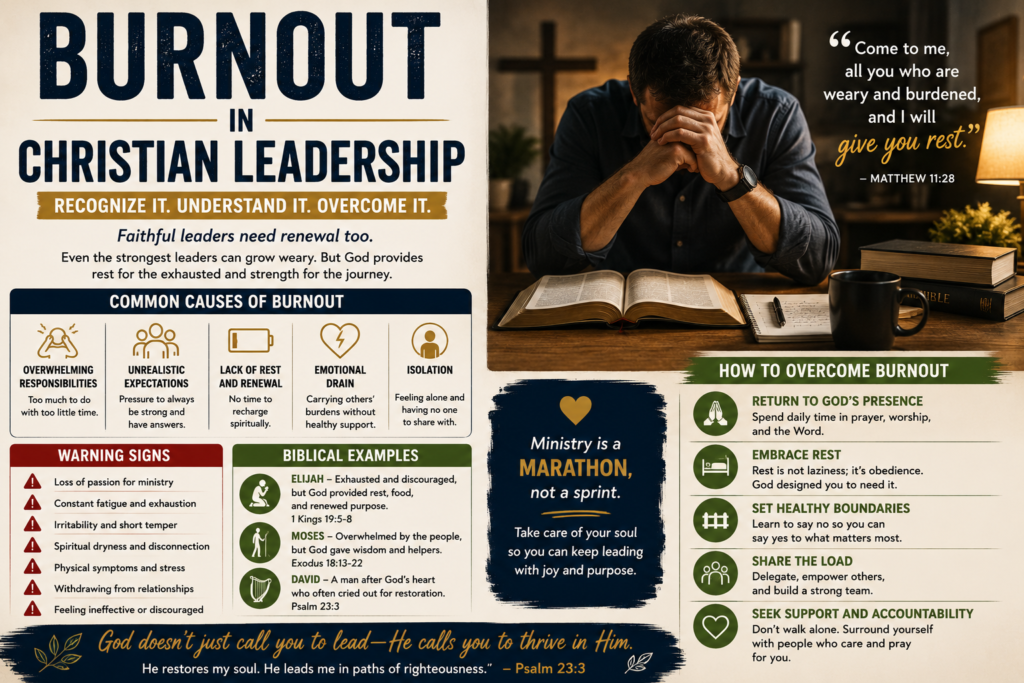

Christian leadership is a sacred calling. It involves serving God by leading people, teaching truth, offering guidance, and caring for others. Yet behind many church pulpits, ministry offices, and leadership roles, there is an often-hidden struggle affecting countless leaders today—burnout.
Many Christian leaders enter ministry with enthusiasm, passion, and a deep desire to serve God faithfully. They commit themselves wholeheartedly to prayer, preaching, mentoring, counseling, and meeting the needs of others. However, over time, the demands of ministry can become overwhelming. Constant responsibilities, emotional burdens, unrealistic expectations, and the pressure to always appear strong can slowly drain even the most dedicated leaders.
Burnout in Christian leadership has become a growing challenge in churches and ministries worldwide. It affects pastors, ministry workers, worship leaders, youth leaders, missionaries, and many others serving in God’s kingdom.
The reality is that leaders who spend their lives pouring into others also need to be spiritually and emotionally filled themselves. Without healthy rhythms of renewal, ministry can move from joyful service to exhausting survival.
What Is Burnout in Christian Leadership?
Burnout is a state of physical, emotional, mental, and spiritual exhaustion caused by prolonged stress and excessive demands.
Burnout does not happen overnight.
It often develops gradually:
- Increased responsibilities
- Constant pressure
- Lack of rest
- Emotional strain
- Neglect of personal spiritual health
Over time, leaders may find themselves functioning externally while feeling empty internally.
Burnout is more than simply feeling tired after a busy week. Resting for a day may relieve ordinary fatigue, but burnout reaches much deeper.
Christian leaders experiencing burnout may feel:
- Spiritually dry
- Emotionally exhausted
- Mentally overwhelmed
- Physically drained
- Disconnected from purpose
The danger is that many leaders continue serving while silently struggling.
Why Christian Leaders Are Vulnerable to Burnout
Christian leadership carries unique challenges that can create conditions for burnout.
1. Constant Giving Without Receiving
Leaders often spend their time:
- Encouraging others
- Counseling families
- Visiting the sick
- Teaching Scripture
- Solving problems
- Carrying ministry burdens
They continually pour out emotional and spiritual energy.
Without intentional renewal, leaders can become empty reservoirs.
2. Unrealistic Expectations
Many church leaders feel pressure from multiple directions.
People may expect leaders to:
- Always have answers
- Never struggle
- Be available at all times
- Handle every crisis
- Maintain perfect families
Such expectations can become emotionally exhausting.
3. Difficulty Setting Boundaries
Some Christian leaders struggle to say no because they fear disappointing others.
They accept every invitation, solve every problem, and respond to every need.
Eventually, the schedule becomes unsustainable.
4. Spiritual Pressure
Unlike many occupations, Christian leadership involves spiritual responsibility.
Leaders often feel pressure to:
- Maintain strong faith
- Lead by example
- Remain spiritually mature
- Provide encouragement regardless of personal struggles
Over time this can become emotionally heavy.
Warning Signs of Burnout in Christian Leadership
Burnout rarely appears suddenly. Usually there are warning signs.
Recognizing them early can prevent serious consequences.
Loss of Passion for Ministry
Leaders who once felt excitement and joy may begin seeing ministry as a burden.
Tasks that once brought fulfillment feel exhausting.
Emotional Exhaustion
Simple situations begin creating intense stress.
Leaders may feel:
- Frustration
- Anxiety
- Irritability
- Discouragement
Spiritual Dryness
Prayer becomes difficult.
Bible reading becomes routine.
Worship loses personal meaning.
Leaders may continue ministering publicly while feeling disconnected privately.
Physical Symptoms
Burnout can affect the body as well.
Possible symptoms include:
- Constant fatigue
- Headaches
- Sleep difficulties
- Low energy
- Frequent illness
Isolation
Some leaders withdraw from healthy relationships.
They avoid conversations and struggle to share personal difficulties.
Isolation often worsens burnout.
Biblical Examples of Leadership Exhaustion
Scripture shows that even faithful leaders experienced moments of discouragement and weariness.
Elijah’s Exhaustion
After experiencing an incredible victory over false prophets, Elijah reached a point of deep emotional exhaustion.
He became fearful and discouraged.
He even prayed that his life would end.
Instead of condemning Elijah, God provided:
- Rest
- Food
- Silence
- Gentle guidance
God understood Elijah’s condition and restored him.
Moses and Leadership Pressure
Moses carried enormous responsibility while leading Israel.
At one point he became overwhelmed and said:
« I cannot carry all these people by myself; the burden is too heavy for me. »
God responded by providing additional leaders to share responsibility.
Moses learned that leadership was never intended to be carried alone.
David’s Spiritual Weariness
David experienced seasons of emotional pain, guilt, and discouragement.
Yet the Psalms reveal his continual return to God.
Psalm 23 reminds believers:
« He restores my soul. »
God remains a source of restoration for leaders today.
The Hidden Dangers of Ignoring Burnout
Ignoring burnout does not eliminate it.
Untreated burnout can create serious consequences.
Damaged Spiritual Life
Leaders may lose intimacy with God.
Ministry activity can replace personal relationship with Christ.
Family Struggles
Exhausted leaders sometimes have little emotional energy left for spouses or children.
Ministry success should never come at the expense of family health.
Reduced Ministry Effectiveness
Burnout affects decision-making, creativity, patience, and compassion.
Leaders operating from exhaustion often struggle to serve effectively.
Moral Vulnerability
Spiritual exhaustion can weaken emotional and spiritual defenses.
Leaders under prolonged stress may become more vulnerable to temptation and poor decisions.
How Christian Leaders Can Overcome Burnout
The good news is that burnout does not have to be permanent.
God offers restoration and renewal.
1. Return to God’s Presence
Spiritual renewal begins with intimacy.
Psalm 46:10 says:
« Be still, and know that I am God. »
Many leaders spend time speaking about God but neglect spending time with Him.
Intentional time with God should include:
- Prayer
- Scripture reading
- Worship
- Silence
- Reflection
God’s presence refreshes weary hearts.
2. Embrace Healthy Rest
Rest is not laziness.
Rest is biblical.
God Himself established rhythms of rest.
Jesus told His disciples:
« Come with me by yourselves to a quiet place and get some rest. »
Leaders need:
- Daily rest
- Weekly rest
- Emotional rest
- Spiritual rest
Healthy rest strengthens long-term ministry.
3. Set Healthy Boundaries
Not every opportunity is an assignment from God.
Leaders must learn:
- To say no when necessary
- To protect personal time
- To prioritize family
- To avoid overcommitment
Boundaries preserve health and effectiveness.
4. Share Ministry Responsibilities
Moses learned that leadership becomes dangerous when carried alone.
Delegation allows:
- Others to grow
- Leaders to rest
- Teams to function effectively
Leadership is stronger when responsibilities are shared.
5. Seek Support and Accountability
Christian leaders need people they can trust.
Healthy support systems may include:
- Mentors
- Pastors
- Friends
- Counselors
- Prayer partners
Leaders need safe places where they can be honest.
The Role of God’s Grace During Burnout
Many leaders feel guilty when experiencing burnout.
They may believe exhaustion means spiritual weakness or failure.
But God does not abandon weary leaders.
Jesus said:
« Come to me, all who are weary and burdened, and I will give you rest. »
Notice that Jesus invites the exhausted.
He does not reject them.
He restores them.
God’s grace meets leaders in moments of weakness and provides strength for new beginnings.
Frequently Asked Questions
1. What causes burnout in Christian leadership?
Burnout often results from prolonged stress, excessive ministry demands, lack of rest, emotional strain, and neglect of personal spiritual health.
2. Is burnout a sign of weak faith?
No. Even biblical leaders like Moses and Elijah experienced exhaustion and discouragement.
3. How can Christian leaders prevent burnout?
Leaders can prevent burnout through prayer, rest, healthy boundaries, accountability, and regular spiritual renewal.
4. Can burnout affect spiritual life?
Yes. Burnout can reduce passion for prayer, worship, and personal intimacy with God.
5. Is rest biblical for leaders?
Yes. God established rhythms of rest, and Jesus regularly withdrew for prayer and renewal.
6. Can leaders recover from burnout?
Absolutely. With God’s help, healthy practices, and intentional renewal, leaders can recover and regain strength.
Conclusion
Burnout in Christian leadership is real, but it does not have to define a leader’s journey. Ministry was never intended to be carried through human effort alone. God never called leaders to pour endlessly from empty hearts.
Healthy Christian leadership flows from God’s presence.
Leaders who remain connected to Christ discover fresh strength when they feel weak, peace when pressure rises, and renewed purpose when exhaustion sets in.
The invitation of Jesus remains powerful today:
« Come to me… »
Sometimes the strongest thing a leader can do is stop striving, rest in God’s presence, and allow Him to restore the soul.
Because renewed leaders do not simply survive ministry—they thrive in it.