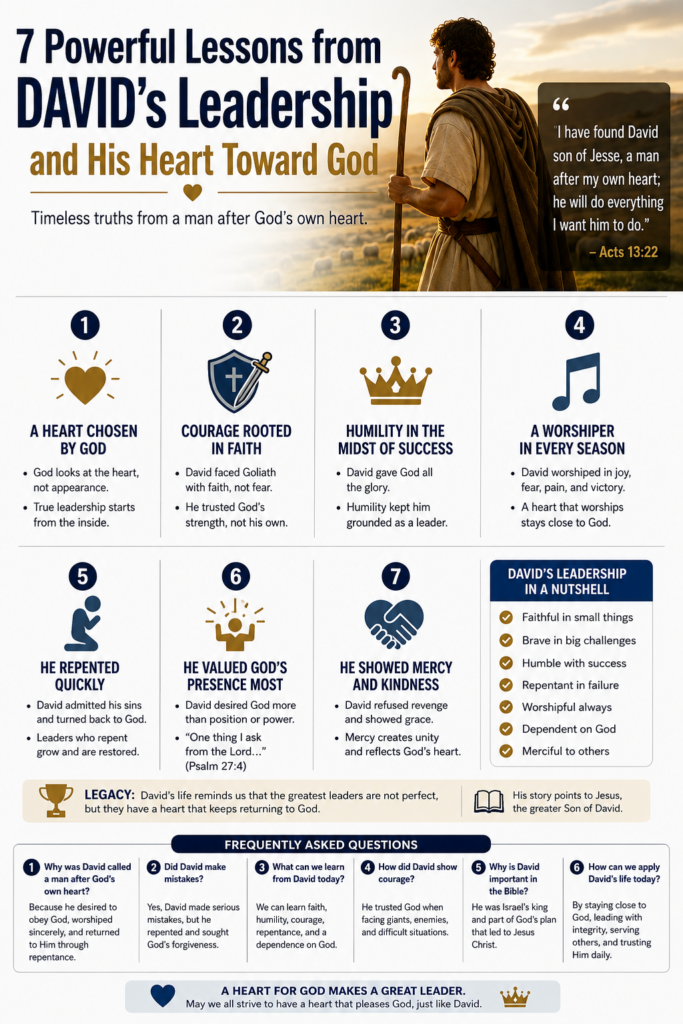

Leadership is often measured by influence, authority, or achievement. Yet the Bible presents a very different picture through the life of DAVID. While he became a king, military leader, poet, and national hero, his greatest distinction was not his accomplishments—it was his relationship with God. Scripture repeatedly points to DAVID as a man after God’s own heart. That description has echoed throughout history because it reveals something deeper than skill or success.
The story of DAVID’s leadership and his heart toward God is filled with victories, failures, moments of courage, and seasons of repentance. Unlike leaders who are remembered simply for power, DAVID teaches us that leadership rooted in faith has lasting impact.
Whether you lead a family, a ministry, a workplace team, or simply seek to influence people around you, DAVID’s life offers principles that remain relevant today.
Who Was DAVID?
Before exploring his leadership qualities, it is important to understand who DAVID was.
DAVID was the youngest son of Jesse, a shepherd boy from Bethlehem who later became king of Israel. His journey to leadership did not begin in a palace. It started in fields filled with sheep.
Many people would have overlooked him. Even the prophet Samuel initially assumed one of DAVID’s older brothers would become Israel’s next king. Yet God saw something beyond appearance.
The Bible says:
« People look at the outward appearance, but the Lord looks at the heart. »
This statement became the foundation of DAVID’s life story.
God selected him not because he looked like a king but because his heart aligned with God’s purposes.
Leadership Begins with Character
One of the most remarkable aspects of DAVID’s leadership was that it developed long before he received a title.
Modern culture often teaches that leadership starts when someone receives authority. DAVID’s life shows the opposite.
Faithfulness in Small Responsibilities
As a shepherd, DAVID had ordinary tasks:
- Watching sheep
- Protecting them from danger
- Spending long hours alone
- Serving his family
These responsibilities may have seemed insignificant, but they prepared him for greater assignments.
When DAVID later faced Goliath, he explained that protecting sheep from lions and bears had built his confidence in God’s protection.
Leadership is often formed in hidden places.
Many people desire public influence while overlooking private preparation. DAVID understood that faithfulness in small things matters.
DAVID Demonstrated Courage Rooted in Faith
The story of DAVID and Goliath remains one of the most famous stories in history.
The giant warrior Goliath terrified Israel’s army. Soldiers saw an impossible enemy.
DAVID saw something different.
He saw a challenge standing against God.
Faith Changed DAVID’s Perspective
DAVID’s confidence did not come from military experience.
He said:
« The Lord who rescued me from the paw of the lion and the paw of the bear will rescue me. »
Notice something important:
DAVID focused more on God’s strength than his own limitations.
Strong leaders understand this principle. Fear grows when people focus only on obstacles. Faith grows when people remember God’s power.
DAVID’s courage inspired an entire nation because courage rooted in God often spreads to others.
Humility Was Central to DAVID’s Leadership
Leadership can create pride if people are not careful.
DAVID experienced enormous success:
- Military victories
- National influence
- Popularity
- Wealth
- Royal authority
Despite these achievements, he repeatedly demonstrated humility before God.
He Recognized God’s Ownership
DAVID understood that his abilities and victories came from God.
Rather than taking personal credit, he frequently worshiped and expressed gratitude.
This attitude protected him from believing he was self-sufficient.
Humility does not mean denying strengths.
Humility means recognizing the source of those strengths.
Leaders often struggle when they begin believing their success belongs entirely to them.
DAVID continually returned glory to God.
DAVID’s Worship Revealed His Heart Toward God
Perhaps no characteristic reveals DAVID’s heart more clearly than worship.
Many of the Psalms were written by him. These songs reveal a deeply personal relationship with God.
DAVID worshiped in many circumstances:
He Worshiped During Victory
After experiencing success, DAVID celebrated God’s goodness rather than himself.
He Worshiped During Fear
When surrounded by enemies, DAVID cried out to God honestly.
He Worshiped During Pain
DAVID experienced betrayal, loss, grief, and personal suffering.
Instead of hiding these emotions, he brought them before God.
He Worshiped During Failure
Even after serious mistakes, DAVID returned to God with repentance.
True worship is not limited to joyful moments.
A heart toward God continues seeking Him in every season.
Great Leaders Admit Failure
One reason DAVID’s story feels relatable is that it includes painful mistakes.
DAVID committed serious sins involving Bathsheba and Uriah. His actions brought devastating consequences.
Many leaders attempt to protect their image when they fail.
DAVID eventually chose another path.
Repentance Revealed His Heart
When the prophet Nathan confronted him, DAVID admitted his wrongdoing.
Psalm 51 provides a powerful picture of his response.
Instead of making excuses, DAVID prayed:
« Create in me a pure heart, O God. »
This moment teaches an important leadership lesson.
The difference between a godly leader and an ungodly one is not perfection.
It is response.
Everyone fails.
The question becomes:
What happens afterward?
DAVID returned to God with humility and genuine repentance.
DAVID Valued God’s Presence More Than Position
One of DAVID’s most beautiful qualities was his desire for God’s presence.
Titles and authority did not satisfy him.
He wanted closeness with God.
In Psalm 27 he expressed:
« One thing I ask from the Lord… that I may dwell in the house of the Lord all the days of my life. »
Notice the phrase « one thing. »
DAVID had many responsibilities:
- Leading a nation
- Making military decisions
- Managing political relationships
- Governing people
Yet his greatest desire remained intimacy with God.
Modern life creates endless distractions.
People pursue:
- Success
- Money
- Recognition
- Achievement
- Social approval
DAVID reminds us that God’s presence satisfies the deepest needs of the human heart.
DAVID Showed Mercy Toward Others
Another powerful leadership lesson involves how DAVID treated people.
King Saul repeatedly attempted to kill him.
Eventually DAVID had opportunities to take revenge.
Many would have considered retaliation justified.
DAVID refused.
He Respected God’s Authority
DAVID said he would not harm the Lord’s anointed king.
His restraint demonstrated extraordinary character.
Mercy can be difficult because human instincts often seek revenge.
Strong leadership requires emotional maturity.
DAVID understood that personal vengeance was not his responsibility.
Leaders who extend grace often create environments where healing and unity become possible.
The Lasting Influence of DAVID’s Leadership
Thousands of years later, people still study DAVID.
Why?
Because his leadership extended beyond policies and victories.
His influence was spiritual.
DAVID pointed people toward God.
Even more significantly, the lineage of DAVID ultimately led to Jesus Christ.
The New Testament repeatedly refers to Jesus as the Son of David.
This connection highlights God’s larger purpose unfolding through DAVID’s life.
Though imperfect, DAVID became part of God’s redemptive story.
Practical Lessons We Can Learn from DAVID Today
The life of DAVID offers practical guidance for everyday leadership.
| Leadership Principle | Application Today |
|---|---|
| Faithfulness in small things | Serve well before seeking recognition |
| Courage rooted in faith | Trust God when facing challenges |
| Humility | Give God credit for success |
| Worship | Stay connected with God daily |
| Repentance | Admit mistakes quickly |
| Desire God’s presence | Prioritize relationship over achievement |
| Mercy | Extend grace to others |
These principles apply whether someone leads a church, family, business, or community.
Frequently Asked Questions
1. Why was DAVID called a man after God’s own heart?
DAVID was called a man after God’s own heart because he desired to obey God, worshiped sincerely, and continually returned to God through repentance despite his failures.
2. What was DAVID’s greatest leadership quality?
Many believe humility and dependence on God were among DAVID’s greatest leadership strengths.
3. Did DAVID make mistakes as a leader?
Yes. DAVID made serious mistakes, but he responded with repentance and sought restoration with God.
4. Why is DAVID important in the Bible?
DAVID became Israel’s king and played a central role in God’s plan, eventually leading to the lineage of Jesus Christ.
5. How did DAVID demonstrate courage?
DAVID showed courage by trusting God during difficult situations, especially when confronting Goliath.
6. What can modern leaders learn from DAVID?
Modern leaders can learn humility, faithfulness, courage, mercy, and the importance of maintaining a close relationship with God.
Conclusion
The story of DAVID’s leadership and his heart toward God remains powerful because it speaks to every generation. DAVID was not perfect. He experienced failure, weakness, fear, and brokenness. Yet through all these experiences, his heart consistently moved toward God.
His life reminds us that effective leadership is not built merely on talent or charisma. It grows from character, faith, humility, and a deep desire for God’s presence.
People may remember accomplishments for a season, but hearts transformed by God create influence that lasts far beyond a lifetime.