
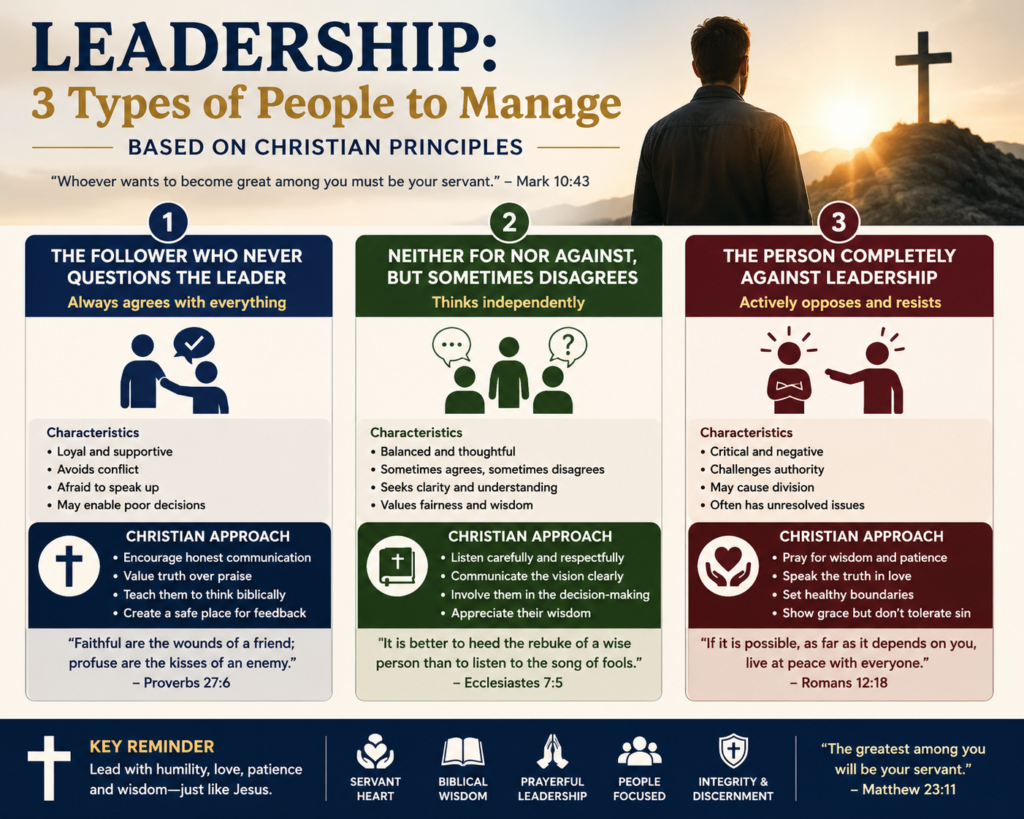

Leadership is never only about strategy, power, or authority. At its core, leadership is about people. Every leader, whether in the church, workplace, ministry, or home, encounters different personalities and attitudes. Some people support leadership completely, others remain undecided, and some actively resist authority.
Understanding these personalities is essential for healthy leadership. More importantly, Christian leadership calls believers to manage people with wisdom, love, patience, and truth. The Bible gives countless examples of leaders dealing with loyalty, disagreement, and opposition. Moses, David, Nehemiah, Paul, and even Jesus Himself experienced all three types of people.
This article explores the three types of people to manage in leadership and how to deal with them according to Christian principles.
Understanding Leadership Through a Christian Lens
Christian leadership differs from worldly leadership. The world often teaches dominance, control, and personal success. Christianity teaches servant leadership.
Jesus said:
“Whoever wants to become great among you must be your servant.” — Mark 10:43
A Christian leader is not called to manipulate people but to guide them with integrity and compassion. Leadership is stewardship. It involves accountability before God and responsibility toward others.
Because people are different, leaders must use discernment. Treating everyone exactly the same may not always be wise. Instead, leaders should understand personalities while still showing equal respect and love.
Why People Respond Differently to Leadership
People respond differently to authority because of:
- Personality traits
- Past experiences
- Trust issues
- Spiritual maturity
- Emotional wounds
- Pride or humility
- Personal ambitions
Some naturally trust leadership. Others question everything. Some carry pain from previous bad leaders. Christian leaders must recognize these realities before reacting emotionally.
The Bible teaches:
“The wise in heart are called discerning.” — Proverbs 16:21
Discernment allows leaders to understand motives instead of simply reacting to behavior.
Type 1: The Follower Who Never Questions the Leader
Every leader encounters loyal followers who agree with nearly every decision. These individuals are supportive, dependable, and encouraging.
At first glance, this may seem ideal. However, blind loyalty can become unhealthy if not managed wisely.
Strengths of Loyal Followers
These followers often:
- Encourage the leader consistently
- Protect unity within the team
- Help execute vision quickly
- Show faithfulness and commitment
- Bring emotional support during difficult seasons
Many biblical leaders had faithful supporters. Joshua stood faithfully beside Moses. Timothy loyally supported Paul’s ministry.
Faithful people are gifts from God.
Dangers of Blind Agreement
However, unquestioning agreement can become dangerous.
A follower who never challenges leadership may:
- Enable poor decisions
- Fear speaking truth
- Become dependent on the leader
- Value approval more than honesty
- Create unhealthy leadership culture
Even strong leaders need accountability.
King David had Nathan the prophet who confronted him after his sin with Bathsheba. Without correction, leaders can drift into pride.
Proverbs 27:6 says:
“Faithful are the wounds of a friend.”
Healthy leadership welcomes wise feedback.
Christian Principles for Leading Loyal Followers
Christian leaders should:
1. Encourage Honest Communication
Create an environment where people feel safe to express concerns respectfully.
2. Avoid Idolization
Never allow followers to place leaders above God. Humility keeps leadership healthy.
3. Teach Independent Spiritual Growth
Followers should develop wisdom and discernment for themselves.
4. Value Truth Over Praise
A leader must prefer honest feedback over constant compliments.
Jesus loved His disciples deeply, but He also corrected them regularly. Christian leadership balances encouragement with truth.
Type 2: The Person Who Is Neither For Nor Against
This person is often balanced and thoughtful. They are not blindly loyal, but they are not rebellious either.
Sometimes they agree with the leader. Other times they question decisions.
Many leaders misjudge these individuals because they are not emotionally expressive or fully committed to one side.
Yet these people can become extremely valuable.
Why Neutral People Sometimes Disagree
Neutral thinkers often:
- Analyze situations carefully
- Need clarity before supporting decisions
- Think independently
- Desire fairness and transparency
- Value logic and wisdom
Disagreement does not always equal rebellion.
In fact, wise disagreement can strengthen leadership.
Ecclesiastes 7:5 says:
“It is better to heed the rebuke of a wise person than to listen to the song of fools.”
A mature leader understands this difference.
The Value of Balanced Thinkers
These individuals can help leaders:
- Avoid emotional decisions
- Consider alternative perspectives
- Improve communication
- Detect weaknesses in plans
- Maintain accountability
In many organizations, balanced thinkers become trusted advisors because they are honest without being destructive.
Biblical Wisdom for Managing This Personality
1. Listen Carefully
Do not become defensive when they disagree.
James 1:19 teaches:
“Everyone should be quick to listen, slow to speak and slow to become angry.”
2. Respect Their Perspective
People who think independently should not be punished for respectfully questioning decisions.
3. Communicate Clearly
Sometimes neutral people simply need more understanding of the vision.
4. Invite Collaboration
When leaders involve thoughtful people in decision-making, trust increases.
Moses listened to Jethro’s advice and improved his leadership structure. Wise leaders learn from others.
Type 3: The Person Completely Against Leadership
This is often the hardest personality for leaders to manage.
These individuals resist authority openly. They may criticize leadership constantly, create division, spread negativity, or challenge decisions aggressively.
Opposition can drain leaders emotionally and spiritually.
However, Christian leadership requires wisdom—not revenge.
Understanding Opposition in Leadership
Not every opponent is evil. Some oppose the fact of being lead because:
- They feel unheard
- They disagree strongly with direction
- They have unresolved hurt
- They struggle with pride
- They desire control
- They distrust authority
Still, some opposition becomes toxic and destructive.
The Bible contains many examples:
- Korah rebelled against Moses
- Saul opposed David
- Religious leaders opposed Jesus
- False teachers opposed Paul
Opposition is part of leadership.
The Spiritual Challenge of Conflict
Leaders often face temptation during conflict:
- Anger
- Pride
- Bitterness
- Revenge
- Discouragement
But Christian leadership calls for spiritual maturity.
Romans 12:18 says:
“If it is possible, as far as it depends on you, live at peace with everyone.”
This does not mean tolerating abuse or allowing chaos. It means responding with godly character.
How Jesus Handled Opposition
Jesus faced constant criticism, betrayal, and resistance.
Yet He demonstrated incredible wisdom.
1. He Stayed Calm
Jesus rarely reacted emotionally to attacks.
2. He Spoke Truth Boldly
Love did not stop Him from correcting wrong behavior.
3. He Chose Battles Wisely
Not every accusation deserved a response.
4. He Maintained Compassion
Even on the cross, Jesus prayed for His enemies.
This is one of the greatest examples of leadership strength.
Essential Christian Leadership Principles
Regardless of personality types, Christian leaders should remain grounded in biblical principles.
Leading With Humility
Pride destroys leadership faster than criticism.
Philippians 2:3 teaches:
“In humility value others above yourselves.”
Humility allows leaders to:
- Accept correction
- Learn continuously
- Admit mistakes
- Serve others genuinely
Practicing Patience and Grace
People grow at different speeds.
Some followers require guidance. Others need healing. Some need discipline.
Grace does not remove accountability, but it changes how leaders respond.
Colossians 3:13 says:
“Bear with each other and forgive one another.”
Using Wisdom Instead of Emotion
Emotional reactions often create unnecessary damage.
Christian leaders should pray before responding to criticism or conflict.
Proverbs 15:1 says:
“A gentle answer turns away wrath.”
Wisdom brings peace and clarity.
Communication Strategies for Christian Leaders
Strong communication prevents many leadership problems.
Be Clear
Confusion creates frustration.
Be Honest
Trust grows through transparency.
Be Respectful
Even correction should honor people’s dignity.
Be Consistent
Inconsistent leadership damages credibility.
Be Prayerful
Christian communication should reflect God’s heart.
Leaders who communicate with wisdom often reduce unnecessary conflict.
The Importance of Discernment in Leadership
Discernment is essential because not every disagreement is rebellion, and not every supporter is trustworthy.
Christian discernment helps leaders identify:
- Healthy feedback
- Hidden motives
- Emotional wounds
- Spiritual attacks
- Wise counsel
Solomon became known for discernment because he asked God for wisdom rather than power.
Leadership without discernment easily becomes manipulation or weakness.
Common Mistakes Leaders Make
Even sincere leaders can make serious mistakes.
1. Favoring Loyal Followers Too Much
This creates unhealthy inner circles.
2. Rejecting Every Critic
Not all criticism is harmful.
3. Leading Emotionally
Emotional reactions often worsen conflict.
4. Avoiding Difficult Conversations
Ignoring problems rarely solves them.
5. Forgetting Prayer
Christian leadership must stay spiritually grounded.
Prayer gives leaders wisdom, peace, and direction.
Frequently Asked Questions
1. Should Christian leaders accept criticism?
Yes. Wise criticism can improve leadership. Christian leaders should evaluate criticism prayerfully and humbly.
2. How should leaders respond to rebellion?
Leaders should respond with wisdom, truth, and calmness while maintaining healthy boundaries.
3. Is disagreement always disrespectful?
No. Respectful disagreement can strengthen leadership and improve decision-making.
4. What does the Bible say about leadership?
The Bible teaches servant leadership, humility, wisdom, integrity, and accountability.
5. How did Jesus lead people who opposed Him?
Jesus responded with truth, patience, courage, and compassion while remaining faithful to God’s mission.
6. Why is discernment important in leadership?
Discernment helps leaders understand people’s motives, make wise decisions, and avoid unnecessary conflict.
Conclusion
Leadership is one of the greatest responsibilities God can give a person. Every leader will encounter loyal followers, balanced thinkers, and strong opponents. Each group requires wisdom, patience, and discernment.
The follower who agrees with everything needs encouragement toward honesty and independent growth. The neutral thinker deserves respect and thoughtful communication. The person against leadership requires wisdom, boundaries, and grace.
Christian leadership is not about controlling people. It is about serving them while honoring God.
Jesus remains the perfect example of leadership. He led with truth, compassion, courage, humility, and unwavering obedience to God. Leaders who follow His example can navigate even the most difficult relationships with wisdom and peace.