

Succession is one of the most critical yet often neglected aspects of leadership. In Christian leadership, succession is not merely about replacing a leader—it is about preserving the purpose God has set across generations. A leader who fails to prepare successors risks leaving behind confusion, division, or even the collapse of what God has built through them.
The Bible provides powerful examples of leadership succession, showing us that God is deeply concerned about continuity. From Moses to Joshua, Elijah to Elisha, and Paul to Timothy, we see a clear pattern: leadership is entrusted, not owned.
This article explores practical, biblical and spiritual principles for succession to be effective in Christian leadership.
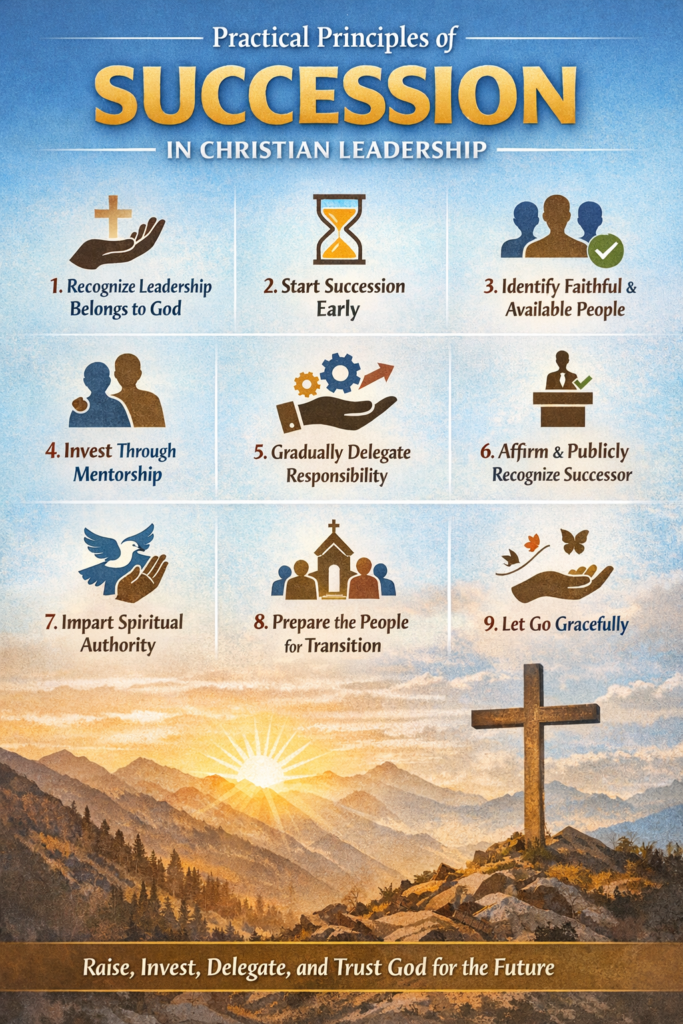
1. Recognize That Leadership Belongs to God
The foundation of succession begins with a correct understanding of leadership: it belongs to God, not to man.
In Scripture, God appoints leaders and also determines their seasons of operation. No leader is permanent except Christ. When leaders see themselves as stewards rather than owners, they become more willing to raise successors.
Jesus demonstrated this principle perfectly. Though He had all authority, He invested deeply in His disciples and prepared them to continue the mission after His departure.
Practical Insight:
Hold your position with open hands. Ask yourself regularly: “If God asked me to hand over this role today, have I prepared someone?”
2. Start Succession Early
One of the greatest mistakes leaders make is waiting too long to think about succession. In the Kingdom of God, succession is not an event—it is a process that is set by the leader, followed through carefully and achieved by implementation.
Moses began preparing Joshua long before his departure. Joshua served, observed, and learned over time. By the time Moses died, Joshua was already functioning as a leader.
Similarly, Paul mentored Timothy and entrusted him with significant responsibilities early on.
Practical Insight:
Do not wait until you are tired, old, or transitioning. Begin identifying and training future leaders now.
3. Identify Faithful and Available People for succession
Succession is not about choosing the most talented person—it is about choosing the right person.
Paul gives a clear criterion in 2 Timothy 2:2:
“Commit these to faithful men who will be able to teach others also.”
Notice the emphasis:
- Faithfulness
- Ability to teach
- Capacity to reproduce
Character outweighs charisma in Kingdom leadership.
Practical Insight:
Look for people who are:
- Consistent
- Teachable
- Spiritually mature
- Loyal to God’s vision
Avoid choosing based solely on gifting or popularity.
4. Invest Deeply Through Mentorship
Succession happens through intentional discipleship. Leadership cannot be transferred through titles or just positions—it must be imparted through relationship.
Jesus lived with His disciples, taught them, corrected them, and sent them out. Paul called Timothy his “true son in the faith,” reflecting a deep mentoring relationship.
Mentorship allows future leaders to:
- Understand the heart behind the vision
- Learn from real-life situations
- Develop spiritual maturity
Practical Insight:
Create intentional mentoring moments:
- One-on-one meetings
- Shared ministry experiences
- Honest conversations about challenges
Succession requires proximity.
5. Gradually Delegate Responsibility
A wise leader does not suddenly hand over everything—they progressively release responsibility.
Jesus first sent out the twelve, then the seventy. Paul assigned Timothy to oversee churches. Moses allowed Joshua to lead battles before becoming the overall leader.
Delegation builds confidence and reveals readiness in the new leader.
Practical Insight:
Give future leaders:
- Small responsibilities first
- Increasing levels of authority
- Opportunities to make decisions
Then evaluate and guide them.
6. Affirm and Publicly Recognize the Successor
Succession must be clear, not ambiguous. Public affirmation prevents confusion, division, and competition.
In the Bible, Moses publicly laid hands on Joshua before the people. This act confirmed God’s choice and established Joshua’s authority.
When leaders fail to clearly communicate succession, it often leads to conflict.
Practical Insight:
At the right time:
- Publicly affirm the successor
- Clearly communicate the transition
- Encourage others to support them
Clarity builds unity.
7. Impart Spiritual Authority, Not Just Position
Christian leadership is spiritual before it is organizational. True succession involves impartation, not just appointment.
Elijah passed his mantle to Elisha. Paul prayed for Timothy and stirred up the gift within him. There was a transfer of spiritual authority and grace.
Without this, a successor may have a title but lack the spiritual capacity to lead effectively.
Practical Insight:
Pray for your successor.
Lay hands on them.
Release spiritual authority intentionally.
8. Prepare the People for succession Transition
Succession is not only about the leader and the successor—it also involves the people being led.
If people are not prepared, they may resist the new leader, even if God has chosen them.
Moses constantly spoke to Israel about Joshua. Paul instructed churches to receive and honor leaders like Timothy.
Practical Insight:
Teach your community about:
- The importance of succession
- Honoring new leadership
- Trusting God’s continuity
Transition becomes smoother when people are prepared.
9. Let Go Gracefully
One of the hardest parts of succession is letting go. Some leaders struggle to step aside, leading to interference, confusion, or control.
True spiritual maturity is demonstrated in the ability to release leadership without insecurity.
John the Baptist said:
“He must increase, but I must decrease.” (John 3:30)
This is the heart of a Kingdom leader.
Practical Insight:
After transition:
- Avoid micromanaging
- Support without controlling
- Trust God’s work in the new leader
Letting go is an act of faith.
10. Trust God for Continuity
Ultimately, succession is not about human effort—it is about God’s faithfulness.
The Church has endured for generations because God sustains it. Leaders come and go, but God’s purpose remains.
Even when transitions are imperfect, God can still work through them.
Practical Insight:
Pray and commit the process to God.
Trust Him to guide, correct, and establish the next leader.
Biblical Examples of Succession
Moses to Joshua succession
A model of structured and intentional succession:
- Close mentorship
- Public commissioning
- Clear transfer of authority
Elijah to Elisha succession
A model of spiritual impartation:
- Faithful following
- Spiritual hunger
- Double portion of anointing
Paul to Timothy succession
A model of relational discipleship:
- Personal mentoring
- Doctrinal instruction
- Delegation of leadership
Each example highlights different aspects of succession but shares the same foundation: intentional preparation.
Common Mistakes to Avoid
- Delaying succession planning
- Choosing based on emotion or favoritism
- Failing to train the successor adequately
- Lack of clear communication
- Refusing to release control
Avoiding these mistakes can save ministries from unnecessary crises.
Conclusion
Succession in Christian leadership is not optional—it is essential. It ensures that God’s work continues beyond one generation and that the vision entrusted to a leader does not die with them.
A true leader does not just build a ministry; they build people who will carry the ministry forward.
As you lead, remember:
- Raise others intentionally
- Invest deeply
- Release faithfully
In doing so, you reflect the heart of Christ, who prepared His disciples to transform the world after Him.
Final Reflection
Ask yourself these questions:
- Who am I currently preparing to succeed me?
- Am I intentionally investing in their growth?
- If I step down today, is the mission secure?
Your answers will determine whether your leadership impact lasts for a season—or for generations.


Pingback: The Manifestation of God’s Love Through Christian Leadership - Fillenium